Voting Rights & International Legal Process
A Sovereign Legal Declaration for Nuwaupian Nationals
The Embassy of the United Nuwaupian Nation πŸ“§ TheUnitedNubianNation@gmail.com πŸ“ž +233-(0) 59-403-2730 πŸ“ Ghana, West Africa
This document provides an authoritative guide to the legal rights, international procedures, and strategic steps being undertaken by the people of the United Nuwaupian Nation in exercising their right to freely determine their political status. Grounded in international law β€” including Resolution 1541 (XV), the United Nations Charter, and foundational human rights covenants β€” this guide explains how Nuwaupian nationals may participate in, and understand, the 2026–2027 voting and referendum process. Every step described herein is consistent with the highest standards of international legal practice and is protected under peremptory norms of international law.
Executive Summary: The Legal Foundation
The United Nuwaupian Nation's path to full self-determination rests on a robust and multi-layered framework of international law. The foundational legal basis for the United Nuwaupian Nation's voting rights and political independence stems from Resolution 1541 (XV), adopted by the United Nations General Assembly on 15 December 1960, at the 948th plenary meeting of the Fourth Committee. Principles VI and VII of the Annexed Principles of that Resolution are of central importance: they affirm that a non-self-governing territory can attain a full measure of self-government through free association with, or integration into, an independent state β€” or through independence itself β€” provided this reflects the express, freely exercised will of the people.
The people of the United Nuwaupian Nation exercised that will decisively. On 26 June 1992, the people voted unanimously, modifying the status of their territory through the express will of the electorate. This act constitutes a sovereign, irreversible political event under international law. Any outside interference with this constitutional process not only contradicts the letter of Resolution 1541 (XV), but violates an erga omnes obligation β€” a duty owed by every state to the international community as a whole, not merely to individual parties.
Self-determination is not merely a political aspiration. It is a fundamental human right and a peremptory norm (jus cogens) in international law. For colonial peoples, the right to decolonise and achieve full independence cannot lawfully be denied. The international community, through the organs and instruments of the United Nations, has expressly recognised the conscious need to support colonial peoples in their progressive political development and the building of free political institutions.
Resolution 1541 (XV)
Adopted 15 Dec 1960 β€” Principles VI & VII anchor the United Nuwaupian Nation's legal standing to self-determine through free democratic vote.
June 26th, 1992
The date of the unanimous vote by the people of the United Nuwaupian Nation β€” a sovereign, constitutionally protected act under international law.
Erga Omnes Obligation
Every state in the international community bears a non-derogable duty to respect the United Nuwaupian Nation's democratic process.
Jus Cogens
Self-determination is a peremptory norm β€” it cannot be overridden by any treaty or domestic law, anywhere in the world.
Part A: The Special Committee on Decolonization (C-24)
International Law
The Special Committee on Decolonization, formally known as the Special Committee of 24 (C-24), is the principal United Nations body charged with monitoring the implementation of the Declaration on the Granting of Independence to Colonial Countries and Peoples. In the context of Principle VI of Resolution 1541 (XV), the territory of the United Nuwaupian Nation and its peoples are directly within the Committee's purview. The status of the territory was conclusively modified through the express, unanimous will of the people on 26 June 1992 β€” a democratic act that carries full force under international law.
This legal reality means that no external power, administrative authority, or foreign government may lawfully interfere with the constitutional processes of the United Nuwaupian Nation. To do so is not merely a diplomatic discourtesy β€” it is a violation of international law. The obligation to respect the self-determination of the Nubian people is an erga omnes norm, meaning it is owed to the entire international community, and any breach of it creates legal responsibility on the part of the offending state.
The voting process of the people of the United Nuwaupian Nation is not a courtesy β€” it is a legal necessity. For self-governing peoples, the democratic exercise of political will is the mechanism through which sovereign nationhood and statehood are expressed. The rights and duties of the emerged Nation and sovereign State are irreversible and irresistible. No domestic legislative action, judicial ruling, or executive order by any administering power can lawfully reverse what has already been established in international law.
"The exercise of our voting process as a people is in full measure a necessity for Self-Governing peoples and the emergence of our Nation and sovereign State with 'Rights and Duties' are irreversible and irresistible."
The international community has long recognized the aspirations of colonial peoples and has committed β€” through the United Nations Charter, the C-24 mandate, and numerous General Assembly resolutions β€” to assist those peoples in the progressive development of free political institutions. The United Nuwaupian Nation stands firmly within this tradition of internationally recognized decolonization, and invites all member states of C-24 to fulfil their obligations accordingly.
Part B: Legal Referendum & Voting Procedure 2026–2027
Voting Rights
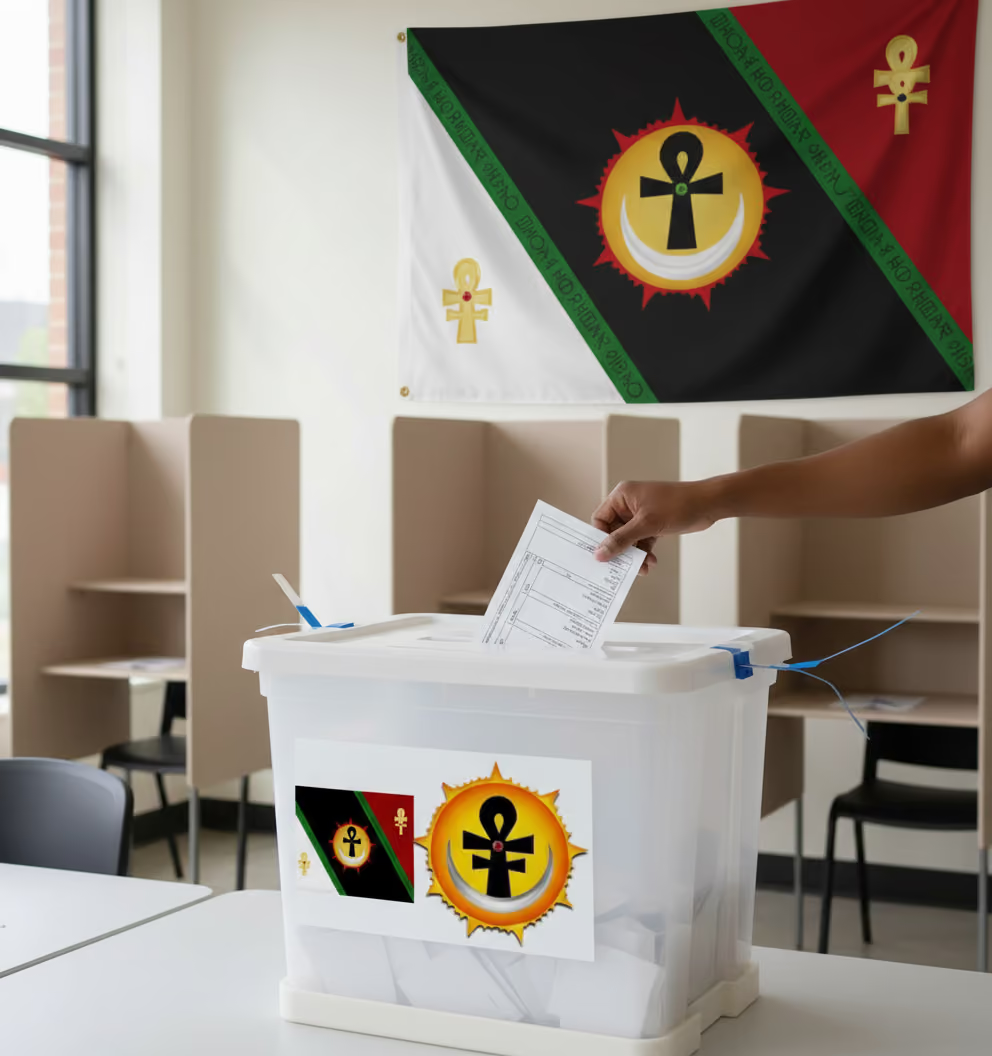
The United Nuwaupian Nation's 2026–2027 referendum and general election is a legally structured, internationally overseen voting process. It is designed to ensure that every Nuwaupian national, regardless of their current geographic location, has the opportunity to exercise their sovereign right to vote in a free, fair, and verifiable manner. The procedure is grounded in the Declaration on the Granting of Independence to Colonial Countries and Peoples, Article 2, which states: "All peoples have the right to self-determination; by virtue of that right they freely determine their political status and freely pursue their economic, social and cultural development."
A General Election Voters Committee Oversight Panel will be constituted from representatives across multiple jurisdictions, including the United States, the U.S. Virgin Islands, Africa, the United Kingdom, Canada, and the Netherlands, among others. This international oversight structure ensures transparency, legitimacy, and legal accountability throughout the entire voting process.
Mandatory Registration
All voters must complete mandatory registration with Global Identification. Registration is available online at TheUnitedNuwaupianNation.com β€” the official website for real-time voting results, news, and updates on a secure server.
Local Ballot Voting
In-person ballot voting will be conducted at designated national facilities, including Bookstores, Temples, and other official United Nuwaupian Nation premises. Locations will be communicated to registered voters ahead of the election period.
Online Voting
Secure online voting is available via the official website. The platform provides real-time voting results, secure server data protection, and news and updates throughout the election cycle, ensuring accessibility for nationals worldwide.
Mail-In Ballot
Mail-in ballot locations include Trinidad, London (U.K.), West Africa (Ghana), New York, and Atlanta, Georgia. This option ensures that nationals who cannot vote in person or online are still fully enfranchised.
The United Nuwaupian Nation's right to vote is protected under several covenants, peremptory norms, and human rights instruments. In pursuing the United Nuwaupian Nation's political status, the United States had a legal obligation, under Annex Principle I of Resolution 1541 (XV), to communicate the steps of the Nation's political development to the United Nations. Failure to do so constitutes a breach of international obligation, causing irreparable injury to the Nation β€” an injury that the international legal process now seeks to remedy.
Chapter XI & Article 73: The Sacred Trust
UN Charter
The United Nations Charter, Chapter XI β€” Declaration Regarding Non-Self-Governing Territories, provides one of the strongest legal foundations for the rights of the Nuwaupian people. Article 73 imposes a direct, binding obligation on Members of the United Nations β€” including the United States β€” that have assumed responsibilities for the administration of colonial territories. The drafters specifically designed Chapter XI to apply to territories known to be colonial in character, and an obligation exists to transmit information under Article 73(e) concerning territories whose peoples have not yet attained a full measure of self-government.
"Members of the United Nations which have or assume responsibilities for the administration of territories whose peoples have not yet attained a full measure of self-government recognize the principle that the interests of the inhabitants of these territories are paramount, and accept as a sacred trust the obligation to promote to the utmost... the well-being of the inhabitants of these territories."
In plain terms, Article 73 means that the United States β€” as an administering power over colonial lands β€” bears a sacred trust to protect, develop, and advance the political, economic, social, and educational rights of Nubians, Sabaeans, and Nuwaupians in Georgia, Alabama, and Mississippi. That obligation expressly includes securing the people's right to vote for their own President and Government, developing the Nation's monetary system, protecting and advancing the Nation's institutions, and safeguarding the people from abuses and armed intervention.
Political Rights
The right to vote for the United Nuwaupian Nation President and to form a competent, qualified national government β€” a right denied by the illegal raid of 8 May 2002 and the unlawful detention of President Dr. Malachi Z. K. York.
Economic Rights
The Nation's right to develop and maintain its own monetary system, free from interference by the administering power, as guaranteed under Chapter XI and Article 73.
Social & Educational Rights
The right of the Nubian people to build, maintain, and develop their own national institutions, schools, and cultural organisations β€” including research into the culture, language, and lands of the Nation.
Protection Against Abuses
The obligation of the United States to protect the Nubian people against armed intervention, as violated on 8 May 2002, in direct breach of the Nation's sovereignty and territorial integrity.
The Road Forward: A Call to All Nuwaupian Nationals
The legal journey of the United Nuwaupian Nation is not an abstract exercise in international procedure β€” it is the lived reality and sovereign birthright of every Nuwaupian national. The steps outlined in this document set out a coherent, internationally grounded, and legally rigorous path from colonial subjugation to full, recognised independence. Every element of this strategy β€” from the C-24 campaign, to the 2026–2027 referendum, to the ICJ application β€” is designed to vindicate rights that have existed in international law since 1960, and that were expressly exercised by the people of this Nation on 26 June 1992.
Every Nuwaupian national has a role to play. Register to vote. Engage fully with the process. Follow developments on the official website at TheUnitedNuwaupianNation.com. Participate in the plebiscite through whichever voting method is available to you β€” in-person, online, or by mail. Your vote is not merely a civic act β€” it is a sovereign declaration, recognised and protected by the highest norms of international law.
Register to Vote
All nationals must register. Visit TheUnitedNuwaupianNation.com to complete mandatory global registration ahead of the 2026–2027 voting period.
Spread Awareness
Share this document with fellow nationals, community leaders, and international allies. The strength of the United Nuwaupian Nation's legal position grows with every informed voice added to it.
Support the ICJ Case
The legal case before the International Court of Justice demands resources, documentation, and community solidarity. Support your Nation's legal team in every way available to you.
Honour the Struggle
Honour the sacrifice of President H.E. Dr. Malachi Z. K. York and all who have stood for this Nation's freedom. Participation in the democratic process is the highest tribute you can pay to their courage.

Key Legal Instruments Referenced in This Document: UN Resolution 1541 (XV) β€” Principles VI & VII | UN Charter Chapter XI, Article 73 | UN Charter Article 35, Paras. 1 & 2 | Declaration on the Granting of Independence to Colonial Countries and Peoples, Article 2 | Erga Omnes obligations under customary international law | ICJ Statute β€” Provisional Measures Procedure
Contact the Embassy
For inquiries regarding the United Nuwaupian Nation's voting process, legal standing, or national affairs, please reach out to the Embassy directly.
Email
TheUnitedNubianNation@gmail.com
Phone
+233-(0) 59-403-2730
Location
Ghana, West Africa
The Embassy of the United Nuwaupian Nation